 |
||||||
 |
||||||
|
|||||||||||||
|
|
|
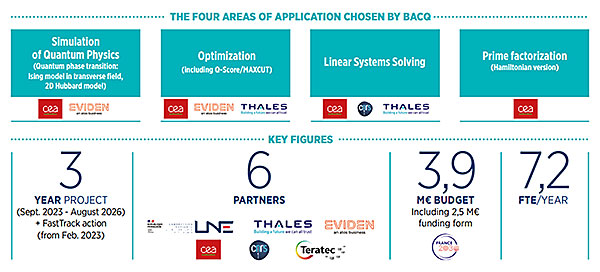
 BACQ, application benchmarks for quantum computers Launched in September 2023, BACQ is the first R&D project in the METRIQs-France programme, led by LNE and dedicated to metrology, evaluation and standardization of quantum technologies. Bringing together Eviden, the CEA, the CNRS, Teratec, the LNE, and Thales in charge of operational management, the project involves establishing benchmarks to assess the performance of quantum computers in terms of concrete applications that make sense for end users. The challenge lies in the diversity of hardware platforms, the specifics in terms of physical characteristics and applications, their maturity and potential rapid development of such technologies... To produce high-level operational indicators for rating the performance of quantum computers, the project will aggregate computational and energy metrics evaluating the resolution of concrete problems covering a wide range of applications: optimization, resolution of linear systems, physics simulation and factorization. Among the metrics considered is the Q-score developed by Eviden to solve the MaxCut optimization problem. Aiming to achieve the widest possible take-up, BACQ's ambition is eventually to provide free access to a set of benchmarks that can be implemented on all types of quantum computers. Role of Teratec Partnering with LNE, Teratec has mission to: Leading the Strategic and Advisory Committee. In conjunction with the BACQ consortium, the aim of this committee is to run an overall strategic review of the project and its direction, taking into account aspects of context, cooperation, exploitation and promotion on a large scale, to include the international level. To ensure relations with industrial suppliers and users of quantum technologies on the one hand, and with European and international initiatives on the other, in order to guarantee that the project is well positioned in a very dynamic scientific and international context. The objective is to enable the better: • monitoring of technologies studied and of benchmarking initiatives at global level, Within this framework, TQCI seminars are devoted annually to the BACQ project and to an overview of international initiatives in this field.
→ 24 & 25 June 2025
In collaboration with the LNE and THALES, TERATEC is organising the 3rd TQCI International Seminar on Benchmarks in Quantum Computing. The two-day conference will review the challenges, needs and progress of various international initiatives. The seminar will bring together researchers and professionals from all over the world for constructive exchanges and enriching discussions.  More information here More information here 
→ 4&5 June 2024 in Reims
New edition of the TQCI seminar dedicated to the state of progress of various benchmarking initiatives for quantum computers. After our first meeting, in 2023, this will be an opportunity to review the progress of the French BACQ project and other European and international projects in the field, to discover new initiatives and to gain an overview of the various strategies. Genuine reference measuring instruments for comparing the performance of the various quantum computing solutions and objectifying their progress towards utility, benchmarks at the component level and especially at the application level remain necessary more than ever, and challenging as well. Organized by Teratec, LNE and Thales, in partnership with URCA, this seminar is a not-to-be-missed opportunity to exchange views with international experts in the field, one year after the one held on May 11, 2023. To allow more time for exchanges with the various participants, this seminar will be held from June 4, 1:00 pm to June 5, 5:00 pm in Reims. Download the slides and watch the videos 
→ 11 May 2023 at Thales
The morning was devoted to a presentation of the French initiative and the BACQ project, followed by discussions with QPU suppliers and manufacturers or structures using these technologies. The afternoon was devoted to the presentation of European and international strategies, with the participation of Yoshiaki SHIMADA, JST-CRDS (Japan), Ye Jun A*STAR (Singapore), Oscar Diez, European Commission, Daniel Opalka, EuroHPC, Philippe Grangier, Qucats, Thomas Strohm, QuIC, Ward van der Schoot, TNO, Matthias Möller, TUDelft, Jeannette Lorenz, Fraunhofer IKS, Amy Henninger, US Department of Homeland Security, Vincent Russo, Unitary fund, Andrew Wack, IBM Quantum
Contact : Emmanuelle Vergnaud
|
|


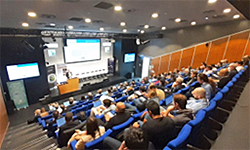 Seminar dedicated to exchanges around the various quantum computer benchmarking initiatives and more particularly those dedicated to applications.